- Unacknowledged AI use is malpractice at every UK awarding body — consequences include disqualification.
- AI is only permitted in assessment when explicitly allowed by the qualification specification, and must be cited.
- Trainers should authenticate suspicious work through oral checks, draft reviews and style sense-checking, not AI detectors alone.
- Ofqual's 'precautionary principle' underpins all awarding body AI policy across England, Scotland and Wales.
1. Why AI Policy Matters Right Now
AI tools like ChatGPT, Google Gemini and GitHub Copilot are now part of everyday life for millions of learners. For vocational qualifications — NVQs, BTECs, T Levels, apprenticeships and more — this creates a real challenge: how do you prove a qualification means something if AI could have written the evidence?
The Core Principle (from every UK awarding body)
Submitted work must demonstrate your own knowledge, skills and thinking. AI-generated content passed off as your own is treated the same as plagiarism — it is malpractice.
Ofqual, the qualifications regulator for England, set out its position clearly in 2024:
"Ofqual's priority is to ensure that where AI is used… it is applied in a safe and appropriate way that does not threaten the fairness and standards of qualifications. To achieve this, Ofqual has adopted a precautionary principle to the use of AI."
— Ofqual, April 2024
2. What Counts as AI Use in Assessment?
AI isn't just chatbots. Here are the main tools that could affect your vocational assessment:
Generative Text
ChatGPT, Google Gemini, Microsoft Copilot
Used to draft reports, answer questions or write portfolio entries.
Code Generation
GitHub Copilot, Replit AI
Particularly relevant for IT, engineering and digital qualifications.
Image / Media AI
DALL·E, Midjourney
Generating diagrams, illustrations or design assets for creative/technical units.
Grammar & Spell Check
Grammarly, Word's Editor
Generally allowed, as long as the ideas and content are still yours.
Assistive Technology
Speech-to-text, screen readers
Usually permitted for learners with disabilities as a reasonable adjustment.
AI Detection Tools
Turnitin's AI checker
Used by centres to flag potential misuse. Helpful, but not the whole picture.
Important Distinction: Using AI to help you learn (quizzing yourself, understanding concepts) is very different from using AI to produce your evidence. The first is fine. The second is where malpractice rules apply.
3. Allowed vs. Not Allowed — At a Glance
The key question is always: does the submitted work genuinely reflect your own skills and understanding?
Generally Allowed
- Using AI to study or revise before an assessment
- Grammar and spell-checking tools (Word, Grammarly)
- AI-powered assistive technology (speech-to-text, screen readers) approved as a reasonable adjustment
- AI for brainstorming — only if the spec explicitly permits it and you reference the AI
- AI tools mirroring real workplace tools, when the spec explicitly allows and use is acknowledged
Not Allowed (Malpractice)
- Copying or lightly editing AI-generated text and submitting it as your own
- Using AI to answer assessment questions during an EPA or controlled assessment
- Submitting AI-generated images or diagrams without acknowledging them
- Using AI to impersonate you in a recorded or video assessment
- Presenting AI-generated code as your own written program
Malpractice Consequences: Penalties range from losing marks on a unit to full disqualification from the qualification. All UK awarding bodies treat unacknowledged AI use as seriously as traditional plagiarism.
4. What Each Awarding Body Says
Every major UK awarding organisation has published guidance. Here's a clear summary:
| Body | Stance | Key Rule |
|---|---|---|
| Ofqual | Precautionary principle — the regulator | Sets the standard all awarding bodies must follow. AI must not threaten the fairness or validity of qualifications. Any AI use must be safe, appropriate and not replace learners' own demonstration of skills. |
| JCQ | Policy framework underpinning all UK bodies | Updated October 2025. Unacknowledged AI = malpractice. Provides real case examples, updated marking guidance and the baseline rules all awarding organisations adopt. |
| NCFE | Exams: no AI. Projects: only if spec explicitly permits | Learners must submit work that is their own. AI use must be explicitly permitted by the qualification specification and referenced per JCQ standards. Unpermitted AI is investigated as malpractice. |
| OTHM | Learner's own work required; AI misuse = malpractice | All assessed work must authentically represent the learner's own knowledge. Submitting AI-generated content as your own constitutes malpractice and may result in disqualification. |
| Focus Awards | Aligns with Ofqual and JCQ principles | All evidence submitted for qualifications must be the learner's own work. Centres must have malpractice policies that address AI misuse, in line with Ofqual's regulatory requirements. |
The Consistent Message Across All Bodies: Unacknowledged AI = malpractice. Permitted use = only when explicitly allowed by the qualification spec, and always properly cited.
5. For Trainers: How to Spot and Handle AI Misuse
If you're a tutor, assessor or IQA, here's a practical step-by-step process when something feels off about a learner's submission:
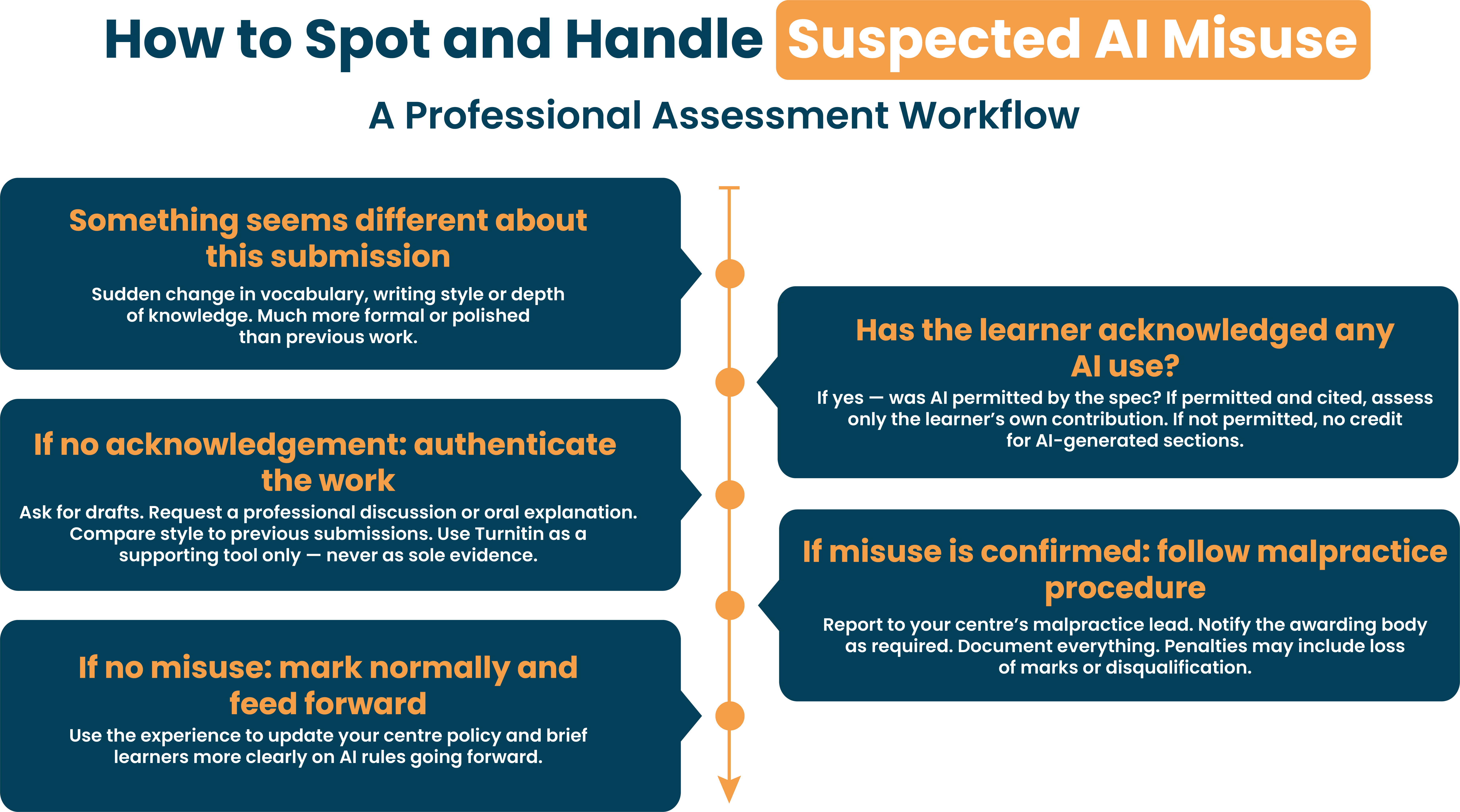
Practical Authentication Techniques
Oral / Viva Check
Ask learners to explain or present their written work. If they cannot justify their own answer, that is a clear red flag.
Draft Evidence
Request earlier drafts, notes or research logs. Pure AI use leaves no genuine drafting trail.
Style Sense-Check
Compare with previous work. Sudden formal vocabulary warrants a quiet follow-up conversation.
Recordings & Logs
Ask for a short video or screencast of the learner navigating their portfolio as proof of authorship.
A Note on AI Detectors: Tools like Turnitin's AI checker are useful but imperfect — both false positives and false negatives occur. Never treat a detection flag as conclusive proof. Always follow up with a conversation before taking action.
6. Designing Assessments AI Can't Fake
The best long-term answer to AI misuse is smarter assessment design. Here's what works:
Make It Personal
Ask learners to reflect on their own real experience: "What went well in your practice session and what would you do differently next time?" AI cannot recall your learner's specific placement, manager or workplace incident.
Require Real-World Evidence
Photos, videos, annotated observation records, witness testimonies — these root the assessment in reality. A photo of a learner's own mock task or site visit cannot be AI-generated.
Multi-Stage Projects
Collect work in stages — a plan, a draft, a revision, a final submission. The process of revision makes AI outsourcing impractical and gives you comparison points.
Higher-Order Questions
Move beyond factual recall. "Evaluate the approach you took in your last assessment and how it compares to best practice in your sector" requires personal analysis that generic AI cannot produce convincingly.
Unique Scenarios
Give each learner a slightly different case study or dataset. When every learner has different inputs, AI cannot supply a universal answer.
Build in Live Elements
Professional discussions, presentations or observed practice cannot be faked by a chatbot. Even a short verbal debrief after a written task dramatically raises the bar.
7. Frequently Asked Questions
Only if your centre's assignment brief and qualification specification explicitly permit it. If allowed, you must reference the AI tool. The final written content must still be your own. Using AI for early brainstorming ideas and then writing entirely in your own words is the safest approach.
Grammar and spell-check tools are generally fine across all awarding bodies — they help you express your own ideas more clearly. The line is crossed when AI is writing or substantially rewriting your content, not just correcting errors.
Yes, in most cases. Ofqual-regulated awarding bodies including NCFE, OTHM and Focus Awards permit AI-based assistive technology as a reasonable adjustment, as long as it helps you express your own ideas rather than generating content for you. Always confirm the adjustment is approved in advance with your centre.
Your centre will investigate under their malpractice policy. Consequences range from losing marks on that unit to disqualification from the full qualification. The awarding body will be notified. It is treated the same as traditional plagiarism. OTHM and Focus Awards both follow Ofqual's regulatory requirements on this.
No. AI detection tools like Turnitin produce false positives and cannot be used as sole evidence. Your centre must follow a proper malpractice investigation process, which includes giving you the opportunity to respond — for example, through an oral explanation of your work.
Yes. Both OTHM and Focus Awards are regulated by Ofqual, which means they must meet the same regulatory standards on assessment integrity. All submitted work must be the learner's own. AI-generated content submitted as your own constitutes malpractice under Ofqual's framework, which applies to all recognised awarding organisations.
🎓 Ready to Become an AI-Confident Professional?
Enrol onto the Focus Awards Level 3 Award in Artificial Intelligence (AI) in Education and gain a nationally recognised qualification that prepares you for the AI-powered workplace.
- Flexible online learning
- Tutor-supported
- Nationally recognised